How to Get Your Brand Cited by ChatGPT, Perplexity & Google AI Overviews
A practical playbook for AI search visibility: the off-site signals that make AI assistants recognize, recommend, and cite your brand, plus where the real numbers live.
A growing share of buying decisions now start with a question to an AI assistant rather than a Google search. "What's the best project management tool for a small team?" "Which SEO tools are actually free?" Whichever brands the assistant names in response get the click and the benefit of the doubt. The ones it leaves out simply aren't in the room.
Getting named is AI search visibility. It's increasingly as valuable as a high organic ranking, maybe more, because in a generated answer there's no scrolling to position seven.
The encouraging part is that you can earn it. This is the playbook I'd follow, focused deliberately on the off-site work, because that's the half most people ignore.
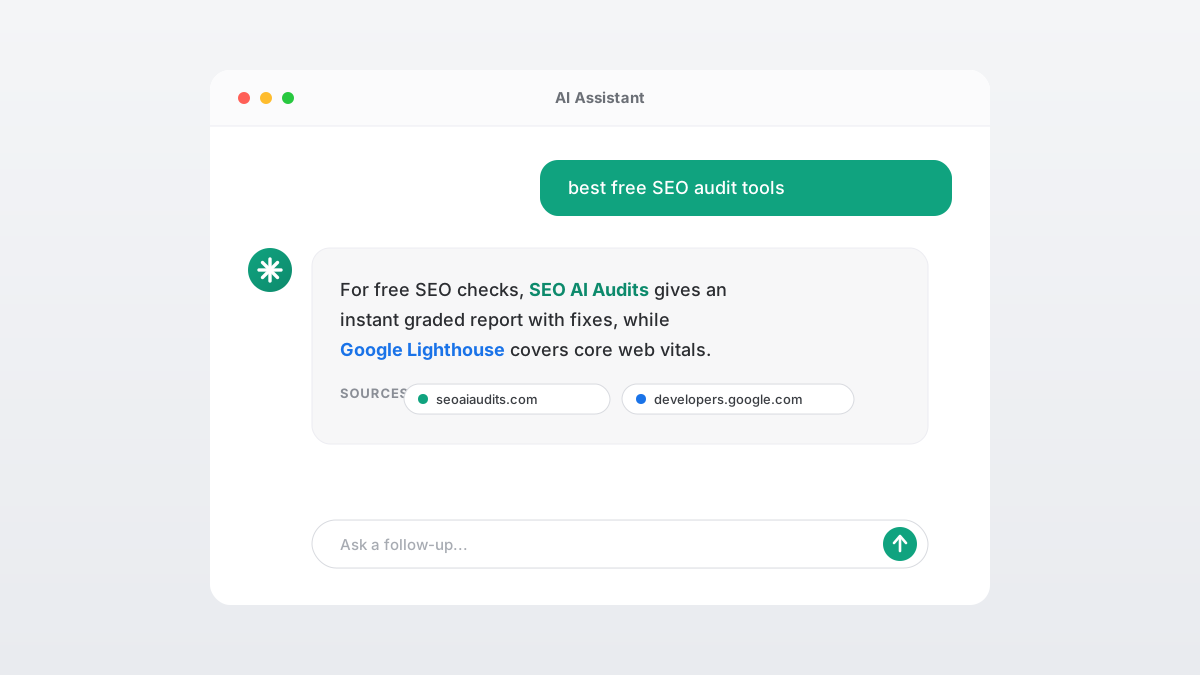
How AI assistants decide who to mention
A model builds its answer from two places: what it absorbed during training, and (for retrieval-based tools like Perplexity or Google AI Overviews) what it fetches live from the web.
To make the cut, your brand needs three things. It needs to be recognised: the model has encountered your name tied to your category enough times to treat you as a real option. It needs to be trusted: you appear on credible third-party sources, not just your own site. And it needs to be clear: there's no ambiguity about what you do or who you serve.
Notice that two of those three are earned away from your website. AI visibility is shaped at least as much by your presence across the web as by your own pages.
The off-site playbook
Build entity recognition
AI models reason about entities. The goal is to make yours unmistakable. Use a consistent brand name and the same crisp one-line category description everywhere you appear: your site, your profiles, directory listings, guest bios. A name that drifts between "Acme", "Acme Inc." and "Acme Analytics" across those places reads as three weak entities rather than one strong one.
If a Wikidata item or Wikipedia entry already exists for your brand, link it from your `sameAs` markup. A Wikidata ID is the most machine-readable anchor you can hand a parser, because it's a stable identifier rather than a page of prose. Don't write your own: Wikipedia requires notability and discourages writing about subjects you're connected to (Wikipedia:Conflict of interest, read 2026-09-23), and no AI engine documents either link as a citation factor. Appearances in reputable industry roundups and comparison pages do the reachable version of the same job: they put your name beside your category on pages someone else wrote.
That same work (one consistent name, third-party pages describing you the same way) is what Google's Knowledge Graph gets built from, and the reasons a brand never appears in the Knowledge Graph are almost always gaps in that entity work rather than a missing tag. You're trying to make the connection between your brand and your category impossible for a model to miss.
Earn genuine third-party mentions
Models are far more willing to recommend a brand that independent sources discuss. The key word is genuine. Chase real coverage: guest articles on industry sites, honest reviews on the platforms your audience actually uses, podcast appearances, partnerships that come with a mention.
Every credible third-party reference strengthens the link between your name and the thing people are asking about. One real write-up on a respected site is worth more here than a dozen low-quality directory entries.
Don't neglect the on-page half
Off-site recognition gets you considered. When a retrieval-based engine visits your page, the page's structure decides whether you get quoted. That on-page work (leading with the answer instead of building up to it, being specific, clean HTML) is its own subject, covered in detail in the GEO guide. Treat the two articles as the two halves of one job.
One prerequisite sits underneath all of this: AI crawlers have to be able to reach your pages. It's surprisingly common to accidentally block OAI-SearchBot or PerplexityBot in robots.txt: a stale file written in the early GPTBot panic, or a catch-all Disallow: / meant for scrapers that inadvertently catches everything. Being allowed in is only half of it: most retrieval crawlers don't execute JavaScript, so text that only appears after a script runs can be absent from the version they actually read. The AI Bot Access Checker tests each major AI crawler against your live robots.txt so you can confirm you're actually reachable.
What we see in our own audits
Our audits measure some of these signals directly, so here is what 43 websites audited on SEO AI Audits between 24 September and 8 October 2026 looked like (sites people chose to audit, so a small sample that leans towards SEO-aware owners):
- Crawler access is rarely the problem. None of the 43 blocked an AI search crawler such as OAI-SearchBot or PerplexityBot in robots.txt, and only one blocked an AI training crawler. If you are invisible in AI answers, a robots.txt mistake is worth ruling out, but it is probably not the cause.
- Most have the basic entity markup. 36 of 43 (84%) had Organization, LocalBusiness or WebSite structured data on their homepage. The markup is the easy part; the third-party mentions it points to are what most brands are missing.
- Long pages often have no figures in them. 31 of 43 (72%) had at least one page of 500 words or more with no statistics or measured data at all. Specific, checkable numbers are the kind of material an answer engine can quote, and they are missing from a lot of long copy.
The most common issues across all the sites we audit are on our research page, updated weekly.
Find out where you actually stand
Two different questions are worth asking here, and no single tool answers both.
The first is whether you are in a model's memory at all. The AI Model Recall Checker asks one AI model (named in the result, alongside its training cutoff) what it remembers about your brand:
- Whether that model recognises your brand, and how confidently it says it does
- Which brands it would name first in your category
- Its own guess at whether it would mention you, prompt by prompt
- A prioritised list of what to focus on first
It answers from training data. No query is sent to ChatGPT, Claude, Perplexity or any live engine, so read the result as whether your brand made it into that model's training, not as a measurement of what any assistant said about you this morning. Anything that happened after the cutoff is invisible to it.
The second question is whether real AI surfaces send you anything, and that one you answer from your own reports. Search Console's Generative AI report shows impressions in Google's AI Overviews and AI Mode, page by page: impressions only, with no clicks and no query dimension (read 2026-09-23). Bing Webmaster Tools' AI Performance shows how often your URLs are cited in Microsoft Copilot and Bing's AI answers (public preview, announced 2026-02-10, read 2026-09-23). Both are free, both are about your site specifically, and only you can open them.
Run the recall check for the memory picture, read those two reports for the real one, then work the playbook.
A realistic timeline
AI visibility is earned over time, not bought. The off-site signals behind it (mentions, citations, recognition) take time to accumulate and time for models to absorb during training updates. Treat it the way you'd treat SEO: steady, compounding effort rather than a one-week sprint.
Pick the queries that matter most to your business, note where you stand in your own reports today, and build from there.
Curious what one model already knows about you? The AI Model Recall Checker is free and takes under a minute.
SEO AI Audits builds free, AI-powered SEO tools and writes practical guides on technical SEO, Core Web Vitals, and how search is changing in the age of AI assistants.
Put this into practice — free
Run a complete, AI-powered SEO audit of your site. No signup.