What Is GEO (Generative Engine Optimization)? A Practical 2026 Guide
GEO is the practice of optimizing your content to be cited by AI search like ChatGPT, Perplexity, and Google AI Overviews. Here's what it means, how it differs from SEO, and how to do it.
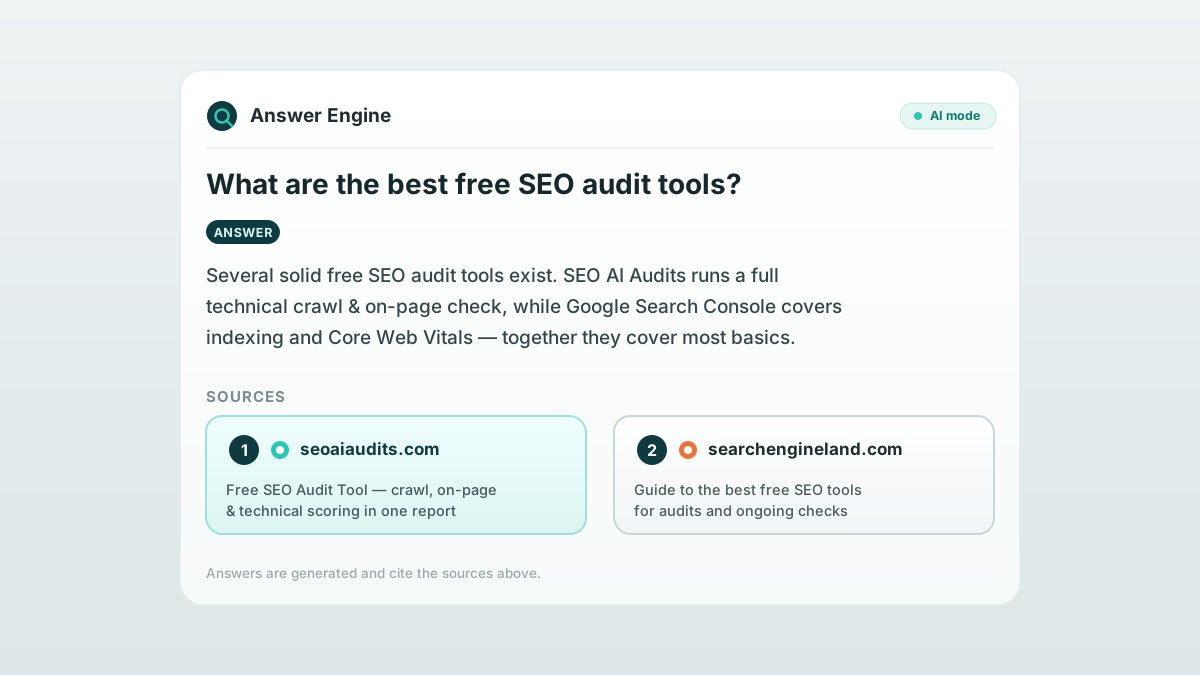
Ask ChatGPT or Perplexity a question and you get a written answer, not a list of ten links. That answer is stitched together from a handful of sources the model decided to trust. Generative Engine Optimization — GEO — is the work of becoming one of those sources.
If SEO is about ranking for a query, GEO is about being the page an AI quotes when it answers that query. Those goals are related, but they don't always point at the same things.
The thing that catches people off guard
A page can rank at position one in Google and still be invisible to an AI assistant.
I've seen it happen. Pages with strong backlinks, solid E-E-A-T, and a top ranking — completely absent from generated answers on the same topic. Not because the model distrusts them, but because the model couldn't find a clean passage to quote.
Ranking rewards accumulated authority: backlinks, engagement signals, trust built over time. Citation rewards something more immediate: whether a specific passage on your page can be lifted cleanly and used verbatim. A page dense with excellent analysis, where every insight takes a paragraph of preamble to understand, will rank well and still get skipped by the AI. Being extractable is its own skill.
GEO, SEO, AEO and AIO: where each sits
The acronyms overlap, but each has a different center of gravity:
| Term | What it optimises for |
|---|---|
| SEO | Rankings in traditional search results |
| AEO | Featured snippets and structured answer boxes |
| GEO | Citations inside AI-generated responses |
| AIO | General machine-readability for LLMs |
You don't pick one. They share a foundation: content that is clearly structured and genuinely trustworthy helps across all four. Get the fundamentals right and you're working toward all of them at once.
How to make a page citable
All of this is on-page work you control directly.
Lead with the answer
If I had to name the single highest-leverage GEO change you can make today, it's this. Open each section with a self-contained answer in the first sentence or two, then expand underneath. An AI pulling a passage wants a clean, quotable unit — not a sentence that only makes sense three paragraphs in.
Readers skimming on a phone want the same thing. This is one of those cases where optimising for machines also makes the content better for people.
Be specific instead of sounding impressive
Marketing language is not quotable. "Improves performance" tells a model nothing it can surface with confidence. "Reduces Largest Contentful Paint by inlining critical CSS" is specific enough to lift verbatim.
Numbers, named standards, dates, and precise thresholds are all quotable. Adjectives like "powerful," "industry-leading," or "comprehensive" are not.
Structure for both machines and people
Headings phrased as the questions people actually ask. Short paragraphs. Lists and tables where they fit. Clean semantic HTML — <article>, <section>, <main> — so a parser can tell your content from your navigation and footer.
The AI Retrieval Checker gives you a concrete read on a single page: an AI model rates it on direct answers, factual density, entity clarity, citable and authoritative signals, semantic structure, and machine-readable main content, then returns a readiness score and fixes. That is one model's judgement of your page, not a measurement of any engine's behaviour.
Add the machine-readable signals
Structured data (schema.org) and consistent entity information — author name, organisation, dates — help a model place your content correctly. Think of these as captions written for software. An `llms.txt` file is not one of them: Google's AI optimization guide says you don't need to create AI text files or markup to appear in Google Search, including its generative AI features (last updated 2026-07-10, read 2026-09-23), and a 2026 Ahrefs server-log study found 97% of llms.txt files were never requested at all (2026-06-15, read 2026-09-23). It is genuinely useful for AI coding agents and documentation sites, which is why we still generate one — we just don't score it.
Show that you're worth citing
GEO rewards credibility. A real author byline, links to primary sources, a visible last-updated date, and content that's actually current all make a page easier to trust and easier to quote. Be precise about what they are, though: these are the same E-E-A-T signals Google publishes as quality guidance for its own ranking systems, and no AI engine documents E-E-A-T as something it uses to decide what to cite. Google's AI optimization guide says there is no AI-specific markup or file to add for its generative features (last updated 2026-07-10, read 2026-09-23). Do this because it makes the page genuinely worth referencing, not because anyone has shown it moves citations.
The other half lives off your site
Everything above lives on your own pages. But whether a model recognises and trusts your brand at all is shaped largely off-site: by how often your name shows up in places the model considers credible.
That side of the equation has its own playbook, which I cover in how to get cited by ChatGPT, Perplexity and AI Overviews. The on-page work here and the off-site work there are the two halves of one job.
The realistic framing
GEO isn't a replacement for SEO. It's the layer that comes after it. The things that make content genuinely useful to a person — clarity, specificity, a trustworthy author, sensible structure — are the same things that make content useful to a model.
Build that foundation and you're ready for the blue links and the AI answer boxes alike.
Want to see where your site stands across GEO, AEO, and traditional SEO? A free SEO audit checks all of it in about a minute, no signup required.
SEO AI Audits builds free, AI-powered SEO tools and writes practical guides on technical SEO, Core Web Vitals, and how search is changing in the age of AI assistants.
Put this into practice — free
Run a complete, AI-powered SEO audit of your site. No signup.