Topic Coverage for AI Search: Why One Good Page Isn't Enough
AI assistants answer one question by looking up several related ones. Here's how that works, why it favours sites that cover a subject fully, and how to find the gaps on yours.
Ask an AI assistant "which running shoes are best for flat feet?" and it doesn't run one search. Behind the scenes it usually breaks the question into several smaller ones: what flat feet need from a shoe, which brands make stability shoes, what runners say about them, how much they cost. Google has described this openly for its AI Mode and calls it query fan-out. Other assistants with live search work in a similar way.
Each of those smaller searches can pull in a different page. The answer you read is stitched together from them.
That changes what it takes to show up. One excellent page on your main topic used to be enough to rank for it. In AI answers, the site that gets used is often the one that has a good page for several of the side questions too.
What "coverage" means here
Coverage isn't about publishing more. It's about having a clear, findable answer to the questions people naturally ask around your subject.
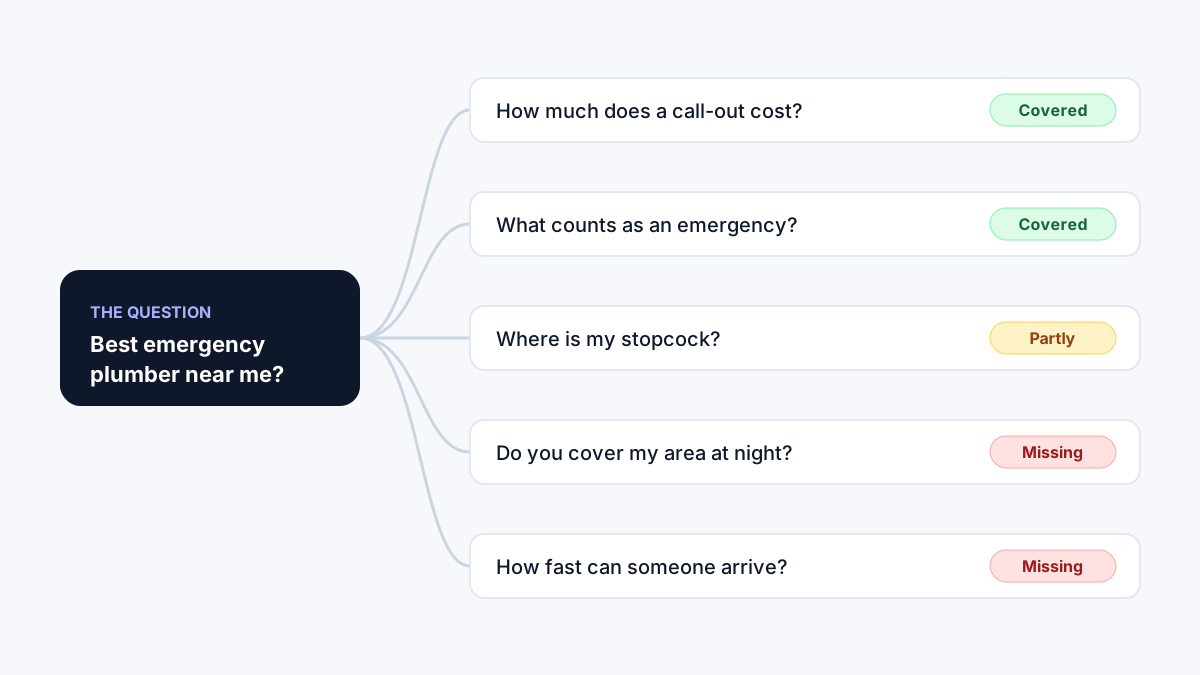
Take a local plumber. The main page might be "Emergency plumber in Leeds". The questions around it are things like:
- How much does an emergency call-out cost?
- What counts as a plumbing emergency?
- Can I turn off my water supply myself, and where's the stopcock?
- Do you cover my postcode at night?
- How quickly can someone arrive?
A site with a short, honest page or section for each of these has five chances to be used. A site with only the main page has one.
How to find your gaps
You can map this by hand in an afternoon.
1. Write down the sub-questions. Start with your main topic and list what a careful customer would also want to know. Search autocomplete and the "People also ask" box are good sources. You can also ask an AI assistant directly: "What questions would someone research before choosing an emergency plumber?" Our Question Gap Finder pulls these from search suggestions for any page.
2. Match each question to a page. For every question, find the one page on your site that answers it best. Be strict. A passing mention in a footer doesn't count; a heading and a clear paragraph does.
3. Mark the result. We use three labels: covered (a page clearly answers it), partly (a page touches on it but doesn't really answer it), and missing (nothing does).
4. Fix the missing ones first, then the partial ones. A missing question usually needs a new page or a new section on an existing one. A partial one usually needs a heading and a direct answer in the first sentence or two, which is the same advice we give for answer engine optimisation.
Mistakes we see
Writing one giant page. Cramming every question into one long page can work for people, but each answer gets buried. Clear sections with question-style headings help, and very different questions often deserve their own page.
Covering questions nobody asks. Coverage should follow real questions, not every keyword variation you can think of. Ten near-identical pages on "plumber Leeds", "Leeds plumber" and "plumbers in Leeds" is the opposite of coverage, and search engines treat it as low quality.
Forgetting the boring questions. Price, area served, opening hours, how long things take. These feel too obvious to write down, and they're exactly what assistants look up before recommending someone.
Checking a competitor and copying their list. Comparing with a competitor is a useful way to spot topics you've missed. Our Content Gap Finder does that side by side. But write your own answers from your own experience; a copied structure filled with thin text helps nobody.
Doing it automatically
If you'd rather not map it by hand, the free audit does a version of this in the AI search tab of every report. It works out the questions people are likely to ask an AI about your subject, then finds your closest page for each one and marks it covered, partly covered or missing. It matches by meaning rather than exact words, so a page titled "Call-out charges" still counts for "how much does an emergency plumber cost?".
Treat the result as a to-do list rather than a score. Every "missing" row is a page worth writing.
SEO AI Audits builds free, AI-powered SEO tools and writes practical guides on technical SEO, Core Web Vitals, and how search is changing in the age of AI assistants.
Put this into practice — free
Run a complete, AI-powered SEO audit of your site. No signup.